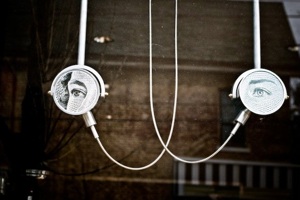
Cyclops stares, depth blind.

Wake less: no dreams.  If Penny

wise, Pound still bullish.

HORN-RIMMED GLASSES / IVORY IMAGISM

Relevant Haiku Ads


EZRA’S (EXACTING ALBEIT ELITIST) EASY-READ EYES


SUPER Snug Pince-Nez!! 

For occasions when those you

must see clearly stink.

previous          next          home

In literature, the gates of horn and ivory distinguish true dreams from false: true dreams come through gates of horn while false dreams through gates of ivory.  The literary image originates in Greek wordplay, in which “horn” sounds like “fulfill” and “ivory” like “deceive.” 
 
Penny is short for Penelope from Homer's Odyssey, who dreams of her husband’s return but, believing the dream came through gates of ivory, does not expect it to come true.  The last character, Ezra Pound, furthered Imagism and the Ideogrammatic Method, which suggests expressing abstract thoughts through linked, concrete images.  An example (per Wikipedia) would be a collage of roses, iron rust, cherries and flamingos subconsciously communicating the abstract trait of “red.”
 
“Cyclops stares, depth blind” is a reference both to the blinding of Cyclops Polyphemus by Odysseus as well as the physiological fact that any one-eye person is incapable of stereo-vision, and therefore lacks depth perception.

This returns us to the two gates.  The common assumption is that horn is good while ivory is bad, true is good while false is bad, etc.  Taken to its logical conclusion, one would always want to see and never to imagine, to be literal and never metaphoric.  This mindset would lead to similes like: a sunset is like a sunset. 
 
This haiku suggests otherwise, that neither gate is good or bad but rather both work together, as do two eyes producing depth and dimension.  I would like to say the haiku’s last sentence is the scholar in me arguing that ivory refuses to be easily dismissed; just as likely though is the punster riffing off the cliche “penny wise, pound foolish."

Does this haiku mean something different to you?  Contact me!  (Fake Google ad at bottom is a bonus joke haiku.)