In the heart or head?

Words turn wheels through sand; yet mute,

chariots away.


BHANTE, WHERE ARE ALL

THE GOOD MEN DEAD?

contact gabriel

previous          next          home

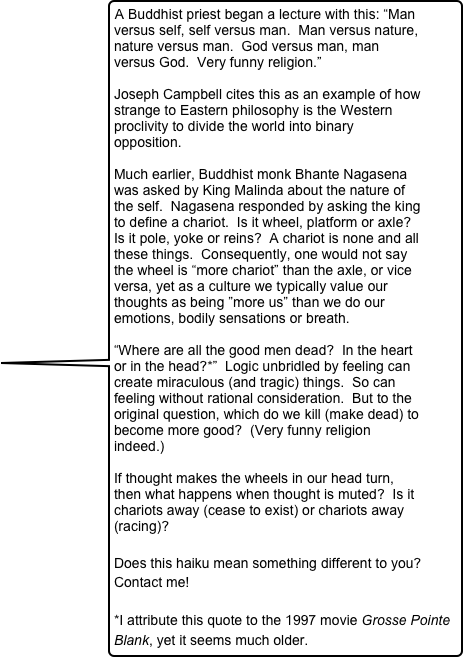
A Buddhist priest began a lecture with this: “Man versus self, self versus man.  Man versus nature, nature versus man.  God versus man, man versus God.  Very funny religion.”
  
Joseph Campbell cites this as an example of how strange to Eastern philosophy is the Western proclivity to divide the world into binary opposition.  

Much earlier, Buddhist monk Bhante Nagasena was asked by King Malinda about the nature of the self.  Nagasena responded by asking the king to define a chariot.  Is it wheel, platform or axle?  Is it pole, yoke or reins?  A chariot is none and all these things.  Consequently, one would not say the wheel is “more chariot” than the axle, or vice versa, yet as a culture we typically value our thoughts as being ”more us” than we do our emotions, bodily sensations or breath.

“Where are all the good men dead?  In the heart or in the head?*”  Logic unbridled by feeling can create miraculous (and tragic) things.  So can feeling without rational consideration.  But to the original question, which do we kill (make dead) to become more good?  (Very funny religion indeed.)

If thought makes the wheels in our head turn, then what happens when thought is muted?  Is it chariots away (cease to exist) or chariots away (racing)? 

Does this haiku mean something different to you?  Contact me! 

*I attribute this quote to the 1997 movie Grosse Pointe Blank, yet it seems much older.

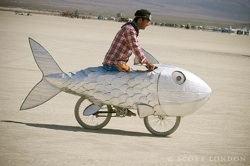
Bhante’s chariot